Why Healthcare Real-World Data Still Misses the Full Patient Story
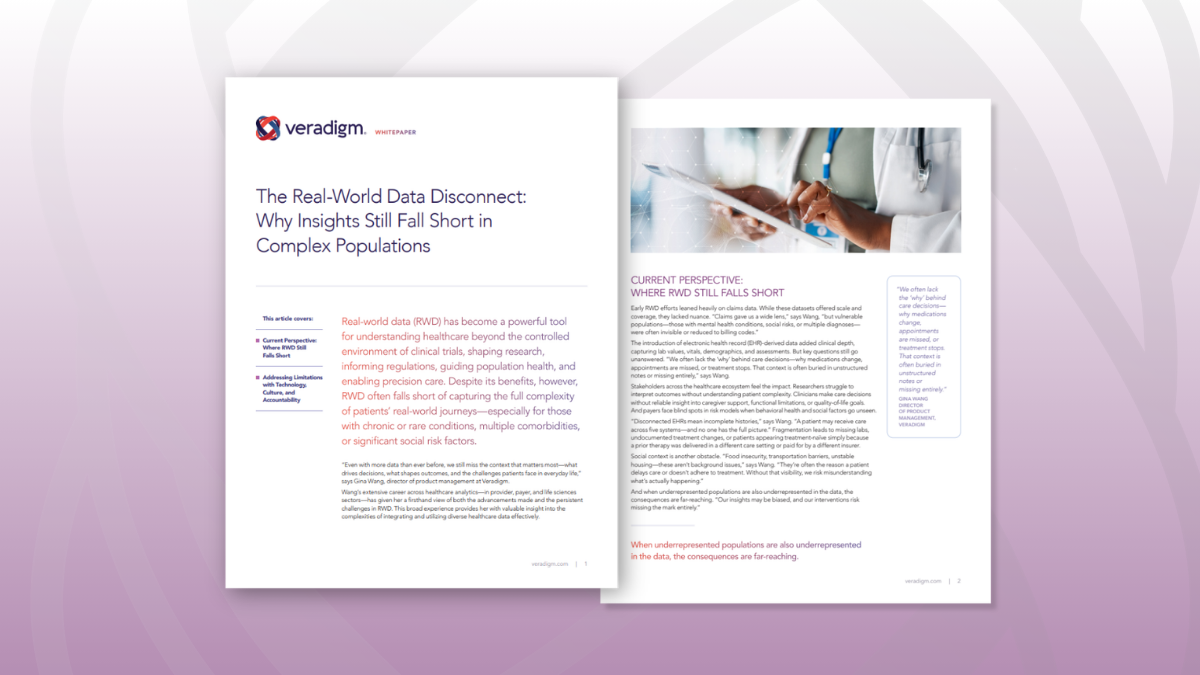
Featured White Paper
Healthcare real-world data (RWD) has transformed how the industry understands disease, treatment patterns, and outcomes beyond the controlled environment of clinical trials. But as data volumes grow across the healthcare ecosystem, a critical gap remains. Too often, real world data fails to capture the full complexity of patient experiences, particularly for individuals with chronic conditions, multiple comorbidities, behavioral health needs, or social risk factors.
The result is growing awareness that more data alone does not automatically lead to better insight, especially when meaningful context is missing.
Where healthcare real world data falls short today
In the white paper The Real-World Data Disconnect: Why Insights Still Fall Short in Complex Populations, Veradigm examines how early RWD efforts relied heavily on claims data. While claims offered scale, they lacked nuance and often reduced complex patients to billing codes.
The introduction of EHR-derived data added important clinical detail, yet key questions still go unanswered. Why was a medication changed? Why did treatment stop? Why were appointments missed? Without the context behind care decisions, healthcare organizations are left interpreting outcomes without understanding what truly shaped them.
The impact of fragmented and incomplete data
These limitations affect every part of the healthcare ecosystem. Researchers struggle to draw meaningful conclusions when patient journeys appear incomplete. Clinicians make decisions without reliable insight into social and behavioral factors that influence adherence and engagement. Payers face blind spots in risk models when mental health and social drivers of care are missing from the data.
Fragmentation further complicates the issue. Patients frequently receive care across multiple settings and systems, leaving no single source with a complete, longitudinal view. As a result, treatment histories can appear inconsistent; care disruptions go unnoticed, and underrepresented populations remain underrepresented in the evidence itself.
Moving from data volume to context and accountability
The white paper outlines how emerging technologies such as natural language processing and artificial intelligence are helping surface insights buried in unstructured clinical notes, including social barriers, caregiver challenges, and patient priorities. Longitudinal data that links clinical and claims sources also plays a key role in revealing patterns over time, not just isolated snapshots.
However, technology alone is not enough. Closing gaps in healthcare real-world data requires a broader commitment to inclusivity, accountability, and equity in how data is designed, evaluated, and used.
Download the white paper to explore how improving healthcare real-world data can support more meaningful insights for complex populations.