Sustaining Independence Is Getting Harder, Not Less Relevant
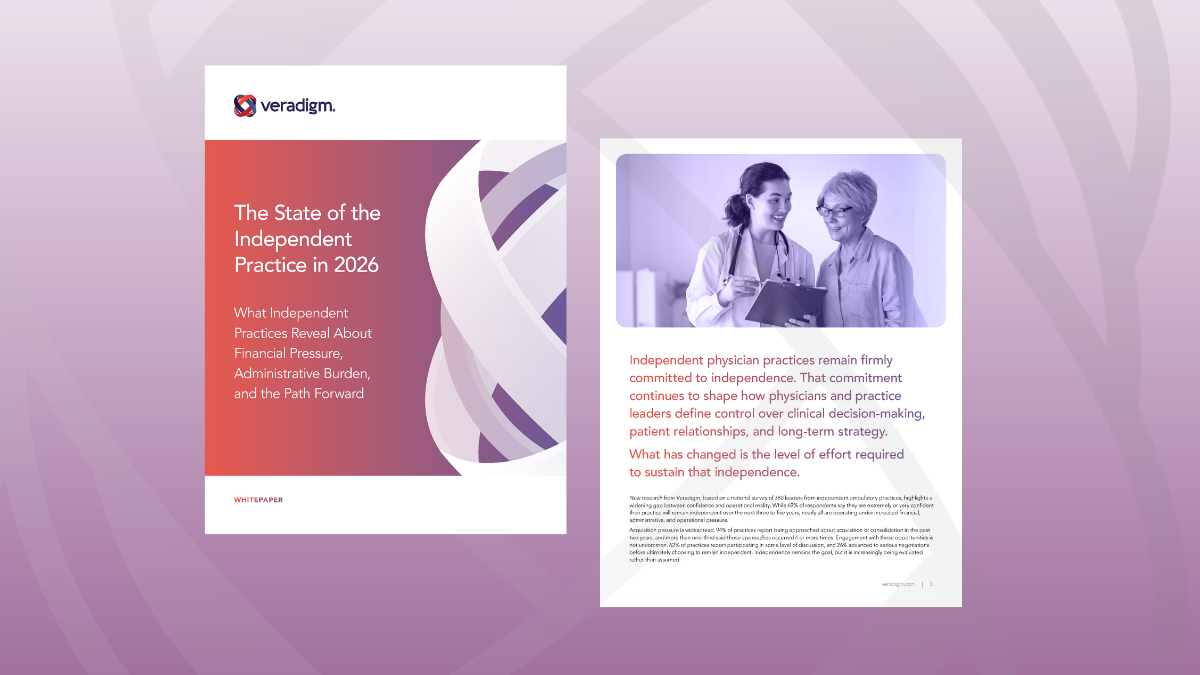
Featured Whitepaper
Independent physician practices remain deeply committed to staying independent, but sustaining autonomy now requires more operational discipline than it did even a few years ago.
In a recent national survey conducted by Veradigm, 69% of 360 leaders from independent, physician‑owned ambulatory organizations say they are extremely or very confident their practice will remain independent over the next three to five years. That confidence reflects how strongly physician‑owned practices value control over clinical decisions, patient relationships, and long‑term direction.
That confidence exists alongside mounting strain. Nearly all practices have been approached about acquisition or consolidation in the past two years, and more than half report increased financial or operational pressure. Independence is increasingly tested by the effort required to sustain it.
Operational pressure is the real threat to independence
The greatest threats to independence today are not clinical. They are operational and financial.
Rising operating costs, administrative and regulatory burden, and reimbursement pressure continue to surface as the most significant challenges across the market. For physician‑owned practices, these pressures strain leadership capacity and execution, increasing risk without stronger financial visibility and operational control.
The impact is not uniform. Larger organizations experience more financial volatility tied to scale and payer complexity, while smaller organizations often carry disproportionate administrative workload relative to staffing.
Revenue cycle complexity is undermining financial predictability
Revenue cycle performance has become a defining factor in whether independent physician practices can maintain control over their future.
Many organizations report rising denial volumes and limited predictability in monthly revenue or cash flow. Visibility into revenue leakage remains constrained, with fewer than one in four practices reporting high or complete insight into losses such as denials, underpayments, and delayed collections.
Timing compounds the challenge. Revenue cycle issues are often identified days or weeks after impact, reinforcing a reactive operating model that limits planning confidence and revenue stability.
Administrative burden is consuming clinical and operational capacity
Administrative workload continues to erode both clinical capacity and operational effectiveness.
More than half of practice leaders describe administrative burden as highly challenging. Most physicians spend at least one hour per day completing documentation outside patient visits, and roughly one quarter spend two hours or more.
Workforce strain intensifies the issue. Recruiting and retaining staff remains difficult across nearly every role, from clinicians and nurses to billing staff and coders. At least one third of practices report difficulty filling each major staffing category, which allows manual work and backlogs to compound.
Technology is increasingly viewed as foundational
Leadership teams remain pragmatic about how to respond.
Technology is no longer viewed as optional. Many leaders see it as essential to long‑term stability when it reduces manual work, improves visibility, and supports more consistent workflows. Automation and AI‑enabled processes are evaluated for their ability to preserve capacity and restore operational control.
As complexity grows, the cost of inefficiency compounds.
What this means for independent practices going forward
Independence still matters. But it is no longer sustained by commitment alone.
Independent physician practices that remain resilient are likely to intervene earlier when performance shifts, reduce reliance on manual processes, strengthen alignment between clinical and administrative teams, and treat technology as core infrastructure rather than an add‑on.
In today’s environment, independence is not a static state. It is an operating model that must be actively managed.
For a closer look at the data behind these trends, download the whitepaper summarizing key findings from Veradigm’s national survey of independent practices.