Unlocking Deeper Insights from Pharma Real World Data
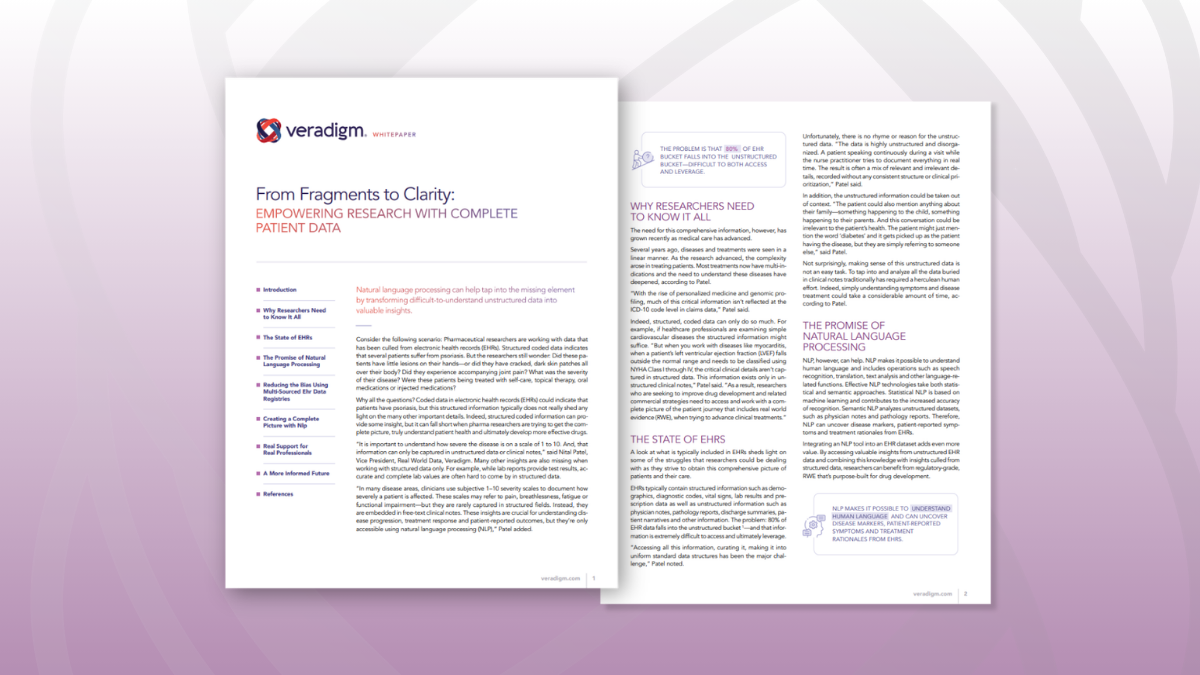
Featured White Paper
Pharmaceutical research depends on understanding the full patient journey, yet much of that story remains out of reach. While structured EHR fields such as codes, labs, and prescriptions provide a foundation, they often miss the context that explains how a disease truly presents, how it progresses, and why certain treatment decisions are made. For researchers relying on pharma real-world data, these gaps can limit confidence in insights and slow progress across the drug development life cycle.
Clinical nuances are frequently documented in free-text notes, not dropdowns or checkboxes. Severity scores, patient-reported symptoms, treatment rationales, and clinician observations are often embedded in narratives that were never designed for analysis at scale. As healthcare has become more complex and personalized, these nuances matter more than ever. Without access to this information, researchers are left working with an incomplete picture of real-world patient experience.
Why unstructured data matters more than ever
Nearly 80% of EHR data is unstructured, residing in physician notes, pathology reports, and discharge summaries. These sources capture the details that distinguish mild disease from severe progression, or initial therapy from treatment escalation. Yet unstructured data is notoriously difficult to standardize and analyze using traditional methods.
Natural language processing (NLP) changes that equation. Applying NLP to clinical text helps researchers extract meaningful signals such as symptom severity, functional status, and treatment response, then combine them with structured data to create analysis-ready datasets. This approach helps transform raw clinical narratives into consistent, regulatory-grade insights that support advanced research.
Creating more trusted real world evidence
When NLP-enriched EHR data is harmonized across multiple sources, it reduces bias and improves representativeness. Multi-sourced registries bring together structured and unstructured data from diverse care settings, geographies, and patient populations. The result is a stronger foundation for pharma real-world data that reflects how care is actually delivered outside of controlled trial environments.
These richer datasets can support a wide range of use cases, from clinical development and regulatory submissions to HEOR, medical affairs, and commercialization planning. Understanding disease severity, progression, and outcomes more completely allows teams to make better-informed decisions throughout the drug development process.
Moving from data access to deeper understanding
The future of pharmaceutical research depends on unlocking insight, not just accumulating data. NLP-enabled approaches provide a path to more complete, accurate, and actionable real-world evidence. To learn how NLP is helping researchers overcome the limits of traditional EHR data and extract greater value from pharma real-world data, download the full white paper and explore what becomes possible when no critical detail is left behind.