A Powerful Tool for Tackling the Physician Burnout Crisis: Ambient AI Scribe Technology

Written by: Katie Wilson, Veradigm, and Cheryl Reifsnyder, PhD
For over a decade, the American Medical Association (AMA) has tracked data on physician burnout in the U.S. These data show that burnout peaked at 62.8% in 2021 during the COVID-19 pandemic; they also show that nearly half (45.2%) of physicians still reported one or more burnout symptoms in 2023. This is an improvement from burnout’s peak value during the pandemic, but the physician burnout rate remains significantly higher in the U.S. than in other nations. For instance, in 2022, the Commonwealth Fund commissioned an international survey of physician burnout rates in 10 developed nations. Excluding the U.S., this survey showed an average physician burnout rate of 34%—compared to 44% for the U.S.
The AMA and other organizations have attempted to reduce physician burnout through interventions ranging from physician wellness initiatives to advocating for regulatory changes to reduce physicians’ documentation burden. So far, these efforts have met with limited success. Physician burnout remains unacceptably high.
Physician burnout negatively impacts patient care and practice revenue, as well as diminishing physician well-being. Physician burnout contributes to higher rates of medical errors and poor patient outcomes. It also leads to physician shortages, which can limit patients’ access to care and disrupt their continuity of care.
The good news is that recent research suggests a solution in the form of relatively new AI technology that can directly decrease clinician burnout: Ambient AI scribes.
Burnout’s primary cause
Multiple studies have shown that 1 of the primary factors contributing to physician burnout is the increasing administrative burden faced by today’s physicians. According to a recent survey by The Harris Poll for Strategic Education, Inc., clinicians spend nearly 28 hours per week on administrative duties. The increasing documentation demands often mean documentation work extends beyond standard clinic hours.
Clinical documentation comprises a significant portion of this growing administrative burden. Documentation requirements have increased substantially due to evolving regulations and payer-specific reimbursement processes. As a result, clinical documentation is a major driver of provider dissatisfaction and burnout.
EHR-based documentation has become more complex and time-consuming. In one study, physicians spent an average of 16 minutes 14 seconds using EHRs per patient visit. Another study found that office-based physicians spend more than 5 hours using the EHR for every 8 hours scheduled with patients. This negatively impacts patient-physician encounters. Providers are spending more and more time on data entry, which limits time available for effective, empathetic communications and care.
Previously attempted solutions have included in-person and virtual scribes, documentation education, changes to documentation workflows, and use of dictation software. Although widely used, speech recognition or dictation software has not clearly reduced the total time required for documentation or produced downstream benefits for clinicians. Human scribes can reduce clinician time in the EHR, but high cost and frequent turnover limit their use. Policy reforms, such as changes to the Centers for Medicare & Medicaid Services coding requirements, have had minimal impact on documentation time.
The potential for ambient AI scribe technology
Early research into the use of ambient AI scribes has identified numerous benefits, suggesting its potential to impact physician burnout.
But first, what is an ambient AI scribe?
Proactive, reactive, intuitive technology
Ambient AI is a subset of artificial intelligence technology designed to be proactive, reactive, and intuitive, making it unique in its ability to solve problems in real time. “Ambient” means that this technology stays in the background until triggered. Once activated, the ambient AI scribe uses machine learning applied to clinician-patient conversations to facilitate scribe-like capabilities in real time.
The goal of an ambient AI scribe is to enhance and simplify providers’ clinical workflows by automatically generating accurate, complete clinical documentation at the point of care. It captures and transcribes real-time patient-provider interactions, then synthesizes the visit transcript with the clinical context to generate structured clinical notes.
Not simply a dictation tool
An ambient AI scribe is not simply a dictation tool. Dictation can occur after the patient visit, whereas the ambient AI scribe captures the patient-physician interaction during the encounter. Dictation tools simply convert spoken words to text; the ambient AI scribe interprets speech and context to generate structured clinical notes.
Early research shows the ambient AI scribe’s effectiveness
Researchers at Stanford studied the effects of ambient AI scribe technology use on a small group (48) of physicians. Results showed:
- About 96% of physicians reported the technology easy to use
- 78% reported that the technology expedited clinical note taking
- About two-thirds reported time savings
A larger study at The Permanente Medical Group deployed ambient AI scribe technology to more than 3,000 physicians. Researchers reported that the technology facilitated more meaningful, personal, and effective interactions with patients and reduced the burden of after-hours documentation.
The demonstrated link between documentation requirements and physician burnout suggests that the ability of ambient AI scribes to reduce clinicians’ documentation time would also decrease the rate of physician burnout.
Ambient AI scribes and physician burnout
These promising results prompted researchers to address the question directly: Could ambient AI scribe technology decrease physician burnout?
In 2025, researchers released preliminary data from a study designed to answer this question. In this study, they evaluated the impact of ambient AI scribe technology use on 2 factors:
- Physician burnout
- Physicians’ perceived well-being
This study included 1,430 clinicians at 2 academic medical center systems, Mass General Brigham (Somerville, Massachusetts) and Emory Healthcare (Atlanta, Georgia). Researchers piloted ambient AI scribe technology to develop AI-generated clinical notes from physician-patient interactions. They found:
- At Mass General Brigham, use of ambient AI scribe technology was associated with a 21.2% absolute reduction (from 52.6% to 30.7%) in burnout prevalence.
- At Emory Healthcare, ambient AI scribe use was associated with a 30.7% absolute increase (1.6% to 32.3%) in the proportion of clinicians reporting a positive impact of their documentation practice on individual well-being.
In addition, a qualitative analysis of free-text survey comments found that physicians’ joy in their practice experience improved with the technology’s use. The researchers concluded that using ambient AI scribe technology was associated with reduced burnout and increased perception of documentation-related well-being.
Fighting burnout with Veradigm
The far-reaching negative impacts of physician burnout make it imperative to address immediately, and ambient AI scribe technology is an effective tool for doing so. That’s why Veradigm released the Veradigm Ambient Scribe technology in late 2024.
Veradigm Ambient Scribe is a HIPAA-compliant, cutting-edge ambient scribe technology designed to ease providers’ documentation burden. This advanced solution converts real-time patient-provider interactions into structured clinical notes, transforming the documentation process without disrupting patient care. documentation burden. This advanced solution converts real-time patient-provider interactions into structured clinical notes, transforming the documentation process without disrupting patient care.
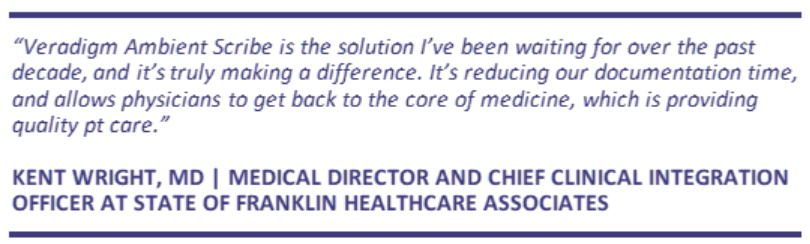
Veradigm Ambient Scribe reduces clinician documentation time, enabling physicians to focus more on patient care. Reduced documentation time increases physician productivity and patient capacity, resulting in greater operational efficiency. It also helps providers enhance the accuracy of medical records, improve patient satisfaction, and ensure compliance. In a survey conducted by Veradigm, 74% of respondents reported reduced documentation time as the greatest benefit of ambient scribe technology.
These benefits result in reduced cognitive stress for physicians, decreased after-hours documentation, and better work-life balance, which work together to reduce physician burnout.
To learn more about Veradigm Ambient Scribe, or to schedule a demo, contact Veradigm today.