Behind the Evidence: Meet Lisa Marchlewicz, Advancing Real-World Evidence for Better Care
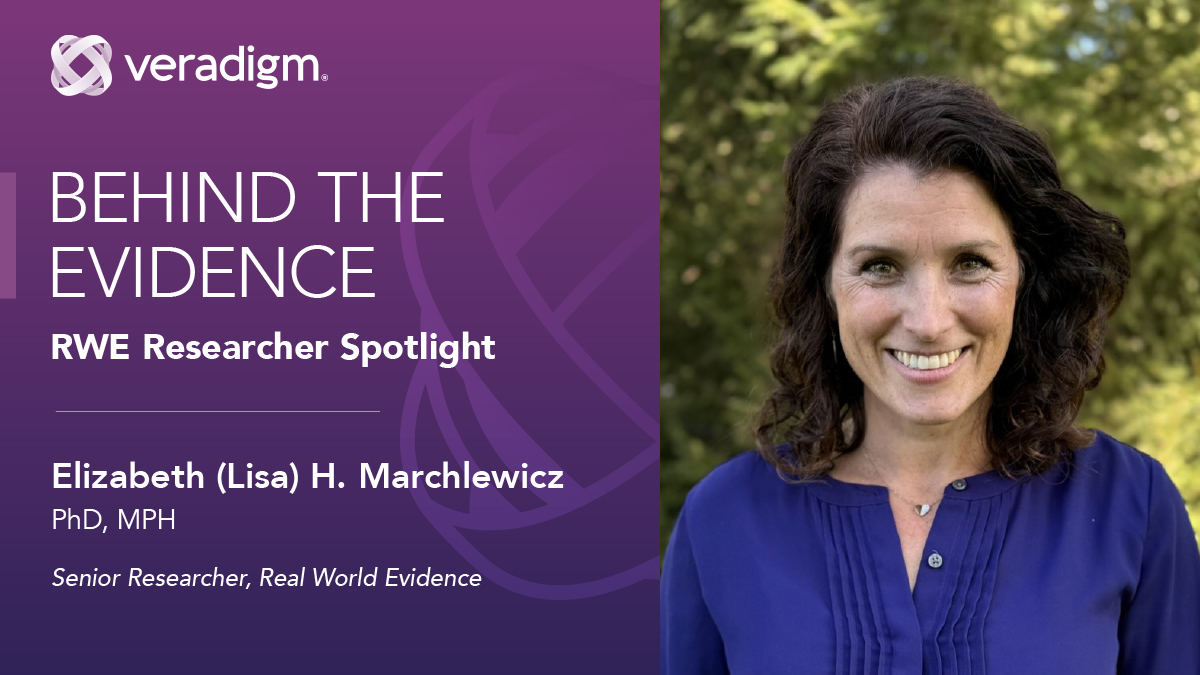
“Behind the Evidence” is a new series spotlighting the people behind Veradigm’s Real-World Evidence research. Each month, we’re sitting down with a member of our Life Sciences research team to talk about their background, the questions driving their work, and how real-world data is shaping healthcare decisions. We’re starting with Elizabeth (Lisa) Marchlewicz, Senior Researcher on our RWE team, whose path from public health to real-world evidence has shaped a career focused on cardiometabolic health, oncology, and mental health, and on what it takes for research to actually change care, not just describe it.
Behind the Evidence – Lisa Marchlewicz
For Elizabeth (Lisa) Marchlewicz, Senior Researcher on Veradigm’s Real-World Evidence team, research has always been about finding ways to improve health at a broader level. With nearly a decade of experience in real-world evidence and 20 years in healthcare, Lisa’s work spans cardiometabolic health, oncology, and mental health. Her path began with an interest in medicine and physiology, culminating in clinical work. However, driven by a desire to influence health beyond one patient at a time, Lisa was drawn to public health and disease prevention. That ultimately led her to real-world evidence research, where she saw the potential to inform healthcare decision-making and create positive change across the healthcare landscape.
That mission is especially meaningful in the therapeutic areas Lisa studies. Cardiometabolic health has been a focus throughout her career, beginning with her early work in preventive cardiology and nutrition, while her interest in oncology and mental health is also shaped by personal experiences as a caregiver. Across these areas, she sees an opportunity to better understand not only disease, but what it means to live with and manage a chronic condition. Among the questions she believes researchers still need to answer are how patients experience their care, what drives provider decision-making, and what barriers prevent people from accessing or continuing care.
For Lisa, this is where real-world evidence research can offer a particularly valuable perspective. Traditional sources such as claims data can tell researchers part of the story, but they may not reveal why a patient discontinued a medication, what symptoms or side effects they experienced, or why a provider made a particular clinical decision. By incorporating information directly from patients alongside EHR data and provider notes, researchers can begin to uncover those missing pieces. Lisa also sees RWE as an important bridge between highly controlled clinical trials and broad population-level research, providing a window into how healthcare is delivered and experienced by patients in everyday settings, including populations that may be underrepresented in traditional research. For example, clinical trials have examined a few specific doses of GLP-1 medications, but real-world data may provide insights into the health benefits of microdosing or non-standard regimens. These insights may later inform clinical standards of care.
Looking ahead, Lisa is most excited about seeing RWE move beyond publication and more directly influence what happens in the clinic. She envisions research helping to inform provider decisions, standards of care, and even how healthcare resources are allocated so that findings translate into tangible improvements in patients’ healthcare journeys. For example, rural community clinics may not have adequate freezer storage capacity which impacts treatment options they can offer patients. As she described it, the opportunity is for research to “jump off the page” and become a catalyst for action.
Outside of research, Lisa spends much of her free time outdoors, whether gardening, trail running, or hiking. Lisa, her husband, their two sons, and two dogs have made it a goal to explore a new forest preserve or state park each weekend. Her family is working to create an edible backyard filled with vegetables, berries, and nuts. Lisa’s love of gardening also has deep family roots: her grandmother was a master gardener, and time spent in the garden today continues to remind Lisa of those experiences with her.
Read the full interview below:
Tell us a little about yourself, your role at Veradigm, and the work you focus on.
Elizabeth: I’m a Senior Researcher on the Real-World Evidence team within Veradigm Life Sciences. I’ve worked in the real-world evidence space for almost 10 years and in the broader healthcare field for 20 years. My general background is in public health, health promotion, and disease prevention. I focus on chronic diseases across a range of therapeutic areas, including cardiometabolic health, oncology, and mental health.
What originally sparked your interest in healthcare and research, and how did your career journey lead you to real-world evidence?
Elizabeth: I’ve had a circuitous route to real-world evidence. I’ve always been interested in human health. I studied physiology as an undergraduate at UCLA and initially planned to go to medical school, but I realized I was more interested in health promotion and disease prevention than treating someone once they were already sick. I decided to pursue a Master of Public Health at the University of Michigan School of Public Health, where I focused on human nutrition.
I then had the opportunity to work clinically at Brigham and Women’s Hospital in Boston. I absolutely loved the individual patient interactions, but I worried that we weren’t making an impact quickly enough at the population level. We were interacting with one person at a time, and I wanted to have a bigger impact—to help change the system and potentially prevent patients from being hospitalized in the first place.
I went back to school to earn a PhD and focused on how the environment, specifically man-made chemicals, impacts human health. I wanted to better understand whether these exposures were contributing to chronic health conditions and what we could do differently to potentially prevent them and help people stay healthy.
After my PhD, I decided I didn’t want to stay in academia because it felt a little too removed. I wanted a career where I felt like the work I was doing every day could make an impact. I was drawn to real-world evidence research because of its potential to inform healthcare decision-making, improve patient care, and potentially improve the healthcare journey. To me, it was an extension of that bigger-picture goal: impacting more people at once and looking at the healthcare system as a whole.
What research topic or area are you particularly interested in right now, and what draws you to it?
Elizabeth: My research focuses primarily on three therapeutic areas: cardiometabolic health, oncology, and mental health. Cardiometabolic health has been a primary interest of mine for more than 20 years. When I first envisioned going to medical school, I thought I would become a cardiologist, and I started working in healthcare in preventive cardiology and nutrition. Later, in graduate school, I focused on the metabolic implications of exposure to endocrine-disrupting chemicals.
Oncology and mental health are more personal for me. My family has been deeply impacted by both cancer and mental health conditions, so I bring the perspective of a caregiver to those aspects of my work. I’m driven by a passion to improve care for other families who may be going through similar experiences. Navigating our complex healthcare system and the often-confusing network of treatment options can be challenging, and I hope the evidence we generate using real-world data can help support those patients and families.
Why is this an important area for researchers and life sciences organizations to be thinking about today?
Elizabeth: From my public health perspective, most Americans are personally impacted in some way by cardiometabolic disease, mental health conditions, or cancer. About half of U.S. adults live with cardiometabolic disease, one in five U.S. adults has a mental health condition in any given year, and one in 10 U.S. adults will have a cancer diagnosis at some point during their lifetime.
These aren’t rare conditions that only specialists manage. They’re chronic health conditions that people across the healthcare industry encounter every day. For many Americans, everyday life involves managing a chronic medical condition—remembering to take medications, considering the next steps in their medical care, or worrying about the cost of care.
There’s also a mental and emotional toll on patients and families that can affect work productivity and other aspects of life. My hope is that our research can help us better understand these conditions and support the development of new, more effective therapies that ultimately decrease disease burden across the population.
What questions within these areas do you think we still need better answers to?
Elizabeth: I think we need to better understand three things: the patient experience, provider decision-making, and barriers to care.
First, what does it actually feel like to be a patient? Second, we need better insight into why providers make the decisions they do and how we can help ensure they have the latest research available to make the most informed decisions possible. Third, we need a better understanding of barriers to care, which can differ across populations and geographic regions.
Earlier in my RWE career, I worked extensively with insurance claims data. Claims data has many strengths, but it can’t always answer these types of questions. Traditionally, claims data has been a major source of real-world insights, but there are important pieces of the patient and provider experience that it doesn’t capture.
How can real-world data and evidence help us better understand or address those questions?
Elizabeth: One of the things that drew me to Veradigm is the opportunity to address some of these questions through real-world evidence solutions for health outcomes research that traditional data sources haven’t always allowed us to do.
For example, we can reach out directly to patients through FollowMyHealth and ask how they feel about a medication they’re taking, whether they would choose to refill it, what symptoms they’re experiencing, or whether they’re having side effects. That gives us an opportunity to hear directly from patients.
We also have EHR provider notes, which can provide information that may never appear in an insurance claim. A provider might document the rationale behind a decision or note why a particular topic wasn’t discussed during a visit. Those details can give us insight into provider workflows, clinical decision-making, and which conversations are being prioritized with different patient populations.
The same applies to barriers to care. We can ask why a patient chose to discontinue a medication. Was it too expensive? Was having to visit a clinic twice a month prohibitive? Would they prefer an oral medication over an injection? Those insights can help us better understand how to serve patients. The ability to work directly with patients and providers prospectively, while also retrospectively examining clinical notes, gives us an opportunity to generate insights into questions that RWD historically hasn’t been as well equipped to answer.
What’s one thing you wish more people understood about real-world evidence?
Elizabeth: I wish more people understood where real-world evidence fits within the broader research landscape. We often have information at two extremes. Clinical trials are conducted among very specific patient populations in highly controlled settings, while broad epidemiologic studies look at trends across entire populations. Real-world evidence can help bridge those two.
RWE allows us to look at the patient level and understand how medicine and healthcare are actually implemented in real-world settings. We can ask what it’s really like to live with type 2 diabetes or pancreatic cancer as an adult in the U.S., or what kind of care someone might receive in a community setting rather than at a large academic institution conducting a clinical trial.
Those insights are important because they can represent the experiences of people who aren’t always represented in traditional health research. RWE can help give a voice to those patients and show what the healthcare experience actually looks like for people living with a particular condition.
It can also highlight gaps between what is possible under ideal circumstances and what patients actually experience. A patient in a clinical trial may have access to a certain level of care, while a patient in a rural community may be limited by what their local clinic can provide. Understanding those differences can show us where patients need greater support and where resources could potentially be better used.
Looking ahead, what developments in RWE or your area of research are you most excited to see?
Elizabeth: What I’m most excited about is the potential for the research we do to start making an even greater impact in the clinic. Right now, a lot of real-world data research becomes a study that gets published, and then it’s up to a pharmaceutical company, academic institution, or another organization to decide how to implement those findings.
What’s exciting to me is the opportunity for our research to inform changes in provider decision-making, standards of care, or even resource allocation. For example, research could help identify whether rural clinics need different resources to ensure they can stock the medications their patients need.
That’s exciting because it means the research could lead to public health implications that patients can tangibly feel throughout their healthcare journey. My hope is that the research can “jump off the page”—that instead of ending with a publication, the findings become an incentive for action in clinics, ultimately supporting providers and improving patient care.
Outside of your work, what’s something you enjoy that people might be surprised to learn about you?
Elizabeth: I spend the majority of my free time outside. I love being in nature, and I spend a lot of time gardening, trail running, and hiking.
My family is working on creating an edible backyard. We’re planting berry and nut bushes along with a large vegetable garden. We have two boys, ages seven and almost 10, and it’s been really fun for them to see how food grows, harvest it, and have food that we can eat and share with other people.
My husband, our two boys, our two dogs, and I also have a hiking goal this fall. Every weekend, we’re visiting a new forest preserve or state park and exploring a different trail.
My love of gardening also comes from my family. My grandmother was a master gardener, and I have memories of going with her to garden club meetings and listening to her talk about plants with her friends. I felt really close to her through gardening. She’s no longer with us, but being in the garden brings those memories back. It feels like a way of staying connected to family and loved ones through the plants.